AI & LLM
Stakeholders Intelligence Platform.
A persistent, compounding stakeholder wiki for innovation workgroups — names, organizations, and the relationships between them, built incrementally by an LLM.
Introduction
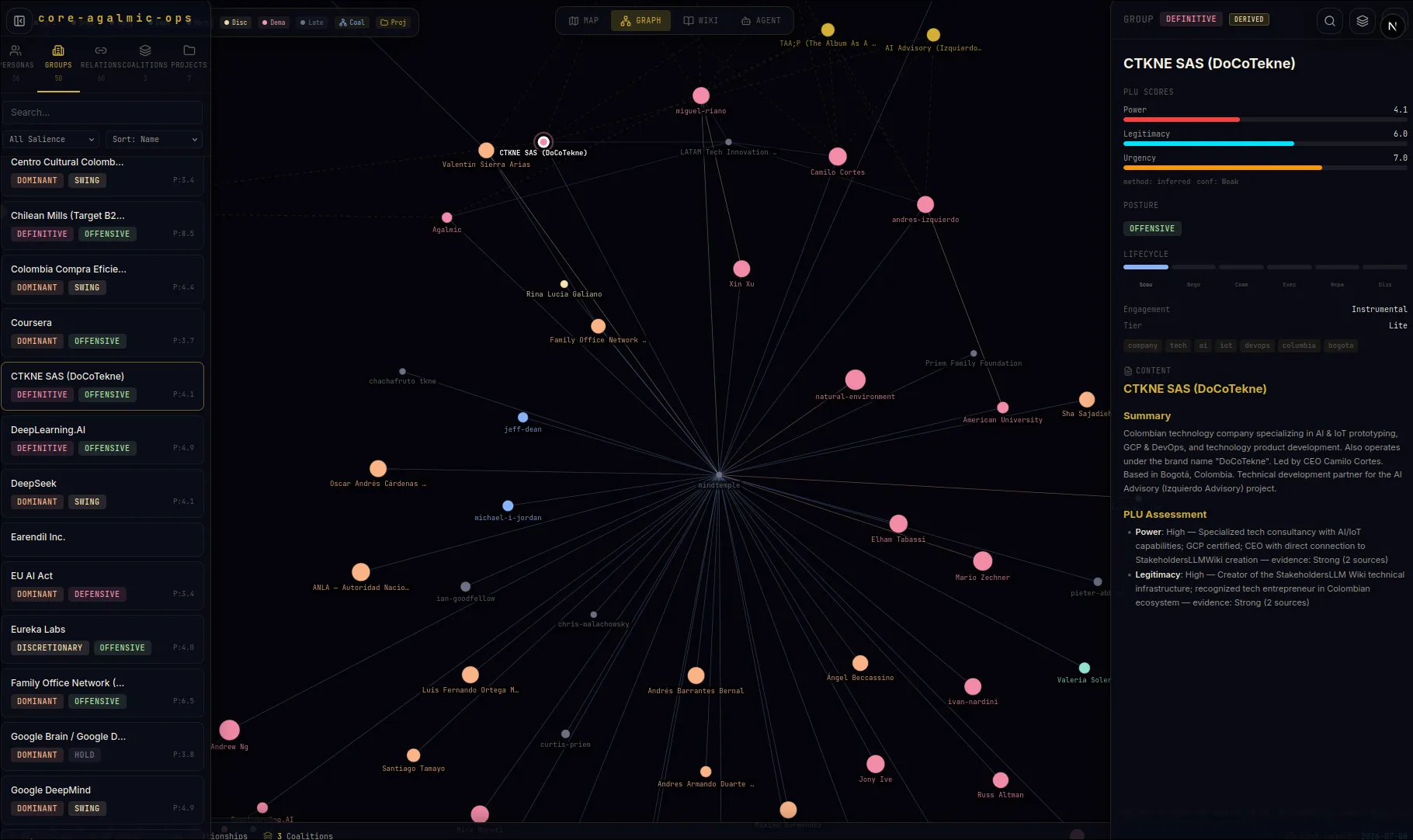
Unlike traditional RAG systems that passively retrieve chunks, this framework acts as a continuous engine: it uses an LLM to incrementally build a structured, interlinked wiki synthesizing “Names and Faces” individuals, organizations, and their interconnections based on deep Stakeholder Theory and Relational Management principles.
Stakeholder Intelligence Wiki
An LLM-maintained knowledge graph for strategic relationship management
- This is not a CRM. It is not a RAG system.
- It is a persistent, compounding knowledge base built on Stakeholder Theory.
- The LLM is the writer — it reads sources, extracts structure, and maintains a living wiki of interconnected markdown files.
The Problem We Solve
Stakeholder knowledge lives in people’s heads.
| Traditional Approach | Stakeholder Wiki |
|---|---|
| CRM spreadsheets that go stale | Linked markdown files — never stale |
| Static PowerPoints each quarter | LLM ingests and updates on demand |
| No theory — pure gut feel | Grounded in PLU salience theory |
| Context lost when people leave | Context is the file system |
| No audit trail of decisions | JSONL change ledger — full audit |
“Intelligence should compound over time — not reset with every meeting.”
Key Design Objectives
- Resilience — Prevent and detect LLM error propagation through structured auditing, canary ingests, regression testing, and field-level change ledgers.
- Accessibility — Reduce cognitive overhead with progressive schema disclosure and tiered (Lite vs. Full) stakeholder profiles.
- Actionability — Move beyond passive dashboards with proactive contradiction resolution workflows, query-based knowledge promotion loops, and generated stakeholder communication templates.
🏗 Architecture
We follow a Linked Network approach where the LLM maintains a directory of interrelated markdown and YAML files. All cross-references, contradictions, and theoretical metrics are kept current through automated workflows, ensuring the system functions as a true compounding intelligence base.